
The plenary report by RAS Academician Leopold Isaevich Lobkovsky, “Generalization of Plate Tectonics Theory for the Current Stage of Earth’s Development Based on a 3D Model of Mantle Convection,” and the plenary report by IEPT RAS Senior Researcher A. A. Baranov, “A Three-Dimensional Convective Model of Mantle Flows Under the Oceans,” examines the problem of choosing a path for global geodynamics in the first half of the 21st century, based on a critical analysis of some of the initial assumptions of plate tectonics theory and the justification for its significant modification and generalization. As a general theoretical platform for the development of modern global geodynamics, incorporating the fundamental principles of plate tectonics, a 3D model of mantle convection for the modern Earth, developed by the scientific group of Academician L. I. Lobkovsky, is proposed. This model is based on seismic tomography data determining its internal structure.
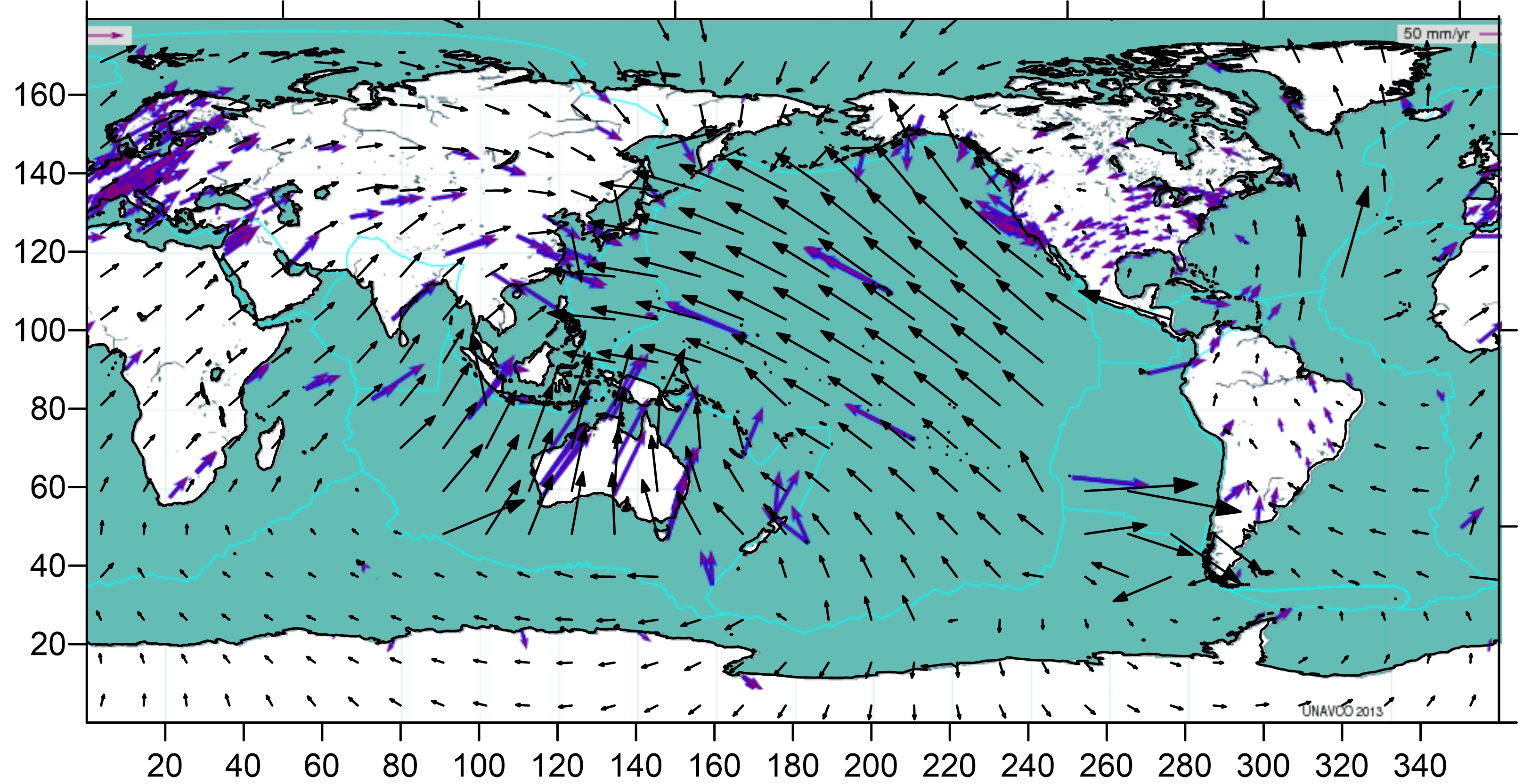
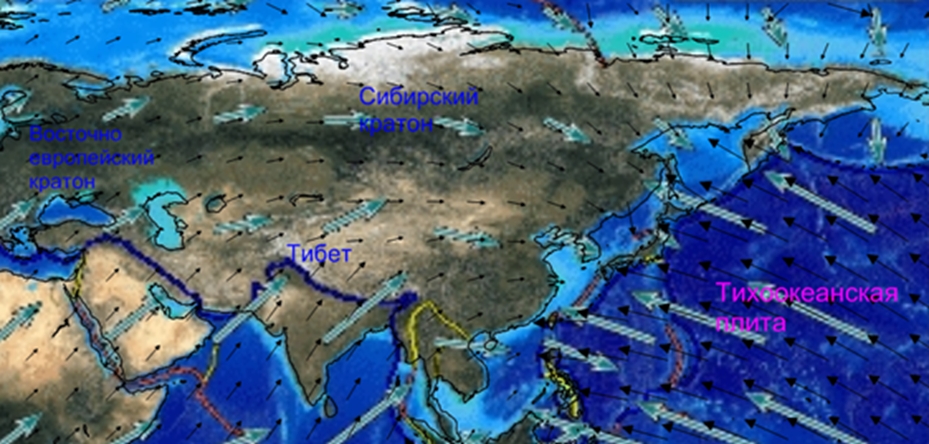
The model automatically takes into account all the main forces acting in the mantle and on the Earth’s surface. Figure 1 shows a comparison of the calculated velocities at the Earth’s surface and those from the ITRF model using GNSS data. Figure 2 shows the model-calculated surface velocities for Eurasia and surrounding regions. The Pacific Oceanic Plate is moving as a whole in a northwesterly direction at a rate of several centimeters per year. The Eurasian Plate as a whole is moving eastward, with velocities within it changing direction, indicating a relatively large magnitude of deformation within this plate. Velocities also change direction significantly for northeast Asia. The magnitudes and directions of the calculated surface velocities correlate with the NUVEL plate kinematics model and with space geodesy data for Northern Eurasia. As previously shown using the Arctic region as an example, the postulate of plate tectonics theory regarding rigid-body rotation of plates on the Earth’s surface (Euler’s theorem), on which the kinematic constructions of plate tectonics are based, is not always applicable. Another fundamental assumption of plate tectonics theory—the complete isolation of lithospheric plates—is also not always fulfilled. For example, the boundary between the Eurasian and North American plates in northeast Asia has not yet fully formed. However, according to the postulates of plate tectonics, this boundary must exist. Therefore, many authors introduce this boundary by introducing additional minor plates (Amur, Okhotsk, etc.), contrary to existing factual data, such as diffuse seismicity. Analysis of these and other tectonic contradictions led to a generalization of classical plate tectonics, in which deformable plates with the possibility of open boundaries were introduced instead of rigid plates. However, this eliminates the possibility of calculating plate kinematics using Euler’s theorem, independent of convective movements in the mantle. A quantitative description of the tectonics of deformable lithospheric plates on a spherical Earth required a three-dimensional model of mantle convection, which significantly complicated calculations of lithospheric motion compared to the Eulerian kinematics of rigid plates. This paper takes a necessary step toward generalizing the theory of plate tectonics. It is based on a convective 3D model of modern global geodynamics, which, relying on real density inhomogeneities of the Earth obtained from seismic tomography data. The constructed 3D model of mantle flows yields a picture of horizontal movements of the Earth’s surface that is in good agreement with satellite geodesy data. It provides a quantitative basis for analyzing the characteristics of regional geological and geodynamic processes occurring in the modern era and in the late Cenozoic. Thus, the convective 3D model of modern global geodynamics can be considered as a real generalization of plate tectonics for the current stage of the Earth’s development.